Search This Blog

Wednesday, April 7, 2010

Youth in the Profession

I REALLY do not want to be the person whining about their age, but ageism is an issue that I face on a DAILY basis. Granted, it does not help matters that I am 26 years old but could pass for a 16 year old. And unfortunately, that is not an exaggeration. This past year I was asked for identification to be granted access to an ‘R’ rated movie! Yeah. At the time, I was thinking exactly what you’re probably thinking: ‘who in the hell asks for I.D. at the movies anyway?’ Whatever, that’s not the point here.

I have found that my age is an issue with anyone and everyone that I interact with regarding my job, whether it is in the office or out in the rest of the world. When I tell people that I work as an ‘architect’ it’s as if they aren’t sure whether or not they should laugh at the hilarious joke I just made. I know that I should technically say that I work as an ‘intern architect’ but for the simplicity of describing my job to non-architects I find it easier to just say ‘architect’. When this matter first came up I would tell people that ‘I work at an architecture firm because I would feel a pang of guilt for saying that ‘I’m an architect’ when I knew in my honest little brain that I was not…yet. But that always lead to the inevitable follow-up question of ‘well what do you do there?’ with an underlying implication of ‘so you answer phones and make coffee?’ I suppose in my current situation the former is not exactly false, but I would prefer to describe the job duties that require the use of my master degree rather than my high school diploma. I mean, I’ll be paying an arm and a leg for that degree for many years to come, so I’d like to reap all the benefits I can get out of it. Can I get a what-what?

Things could be much worse. I am aware of this. I am extremely grateful to be young. Everything is still new and exciting to me. However, overcoming the obstacles and being taken seriously is difficult when you look like you just got your drivers license. The best solution that I have come up with to deal with this issue is to embrace your youth and prove your capabilities to those skeptics through your work. The work should speak for itself, right?


So in the words of Snoop Dogg (because I’m young):

“Nothin’ to it but to do it”.

Monday, April 5, 2010

One.

ONE. What does this number mean to you? What can this number possibly mean to me, my friends and colleagues?

Well, recently I’ve come to understand that ONE is a significant number. ONE minute can be devastating. A proposal that is time-stamped ONE minute late can be a deal breaker for being considered for a project. ONE minute late can take you off the boards for consideration! Now I’m not so sure that punctuality was enforced heavily enough in school!

ONE minute could mean something great too! A proposal time-stamped ONE minute early equals an enormous sigh of relief! Whew! We made it! All of those hours and last minute crises were all worth it! We made it with ONE minute to spare.

ONE minute of my time equals diddly squat of company money, whereas ONE minute of a principal’s time equals like 600% of my time. That’s significant.

ONE degree. If a wall is drawn ONE degree off, that could add up to a LOT of extra dollars spent to construct a wall assuming that the length of the wall is a considerable distance. Think about it. Just ONE degree could be unrecognizable to your eye when working on a 14” computer screen and then, BAM! $4,000 (or more) later it adds up to 25 additional lineal feet (or more) of some ridiculously expensive wall type to a project. That's huge.

ONE inch. The same principles apply here as they did for ONE degree. Imprecise measurements can be a devastating mistake. It’s as simple as that.

ONE is generally considered a small number. ONE dollar isn’t much to anybody anymore. ONE minute seems like a blink of an eye in most circumstances. ONE degree - well, any unit of measure that isn’t precise is generally going to cause problems in the future, so should we really be shocked by this one? ONE inch - (see ONE degree).

And let’s not forget, ONE is the loneliest number.

Wednesday, March 10, 2010

Your Newest Green Associate

This post is coming to you from a LEED Green Associate! Yes, I passed the exam which now makes me a Green Associate. Up next…LEED BD+C.

To be completely honest, passing this exam felt like graduating all over again. Proving that I could accomplish something that is not so easy to accomplish! Starting out in this career has brought on additional insecurities that were unexpected, at least for me. Insecurities that come from 1) not knowing the answers to what seem like simple questions, 2) being at the bottom of the food chain, and 3) well, being treated like an intern. All of those elements were anticipated, yet I have been surprised by how much they have affected my confidence in my work. With that said, passing the LEED GA exam on my first attempt gave me a lift and some reassurance that I am capable!

Saturday, February 27, 2010

Form Follows Function...Or Does It?


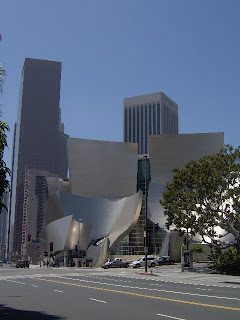
Recently I picked up Conversations With Frank Gehry by Barbara Isenberg after reading a review of it in the latest Architectural Record. I’ve never considered myself a fan of Gehry’s work but I can’t say I’m not continually intrigued and inspired by the work he manages to complete. I have visited a few of Gehry’s projects in the U.S. such as the Disney Concert Hall, Experience Music Project, Weisman Art Museum, and the Pritzker Pavilion and I have to say that they are nothing less than impressive to see in person.

Disney Concert Hall

Experience Music Project


Weisman Art Museum


Pritzker Pavilion


For some reason, however, I cringe at listing Gehry as one of my favorite architects. Maybe it’s his Hollywood celebrity status that disqualifies him in my mind. When I think about what Gehry’s design philosophy is, I can’t help but immediately recall that Simpson’s episode where he gets his inspiration for a town project from a crumpled piece of paper!


After reading through some of Gehry’s interviews, I gained a little more insight into this man’s design philosophy and it posed a familiar question. He approaches a project by designing the object(s) and then designing the space within those objects. It is obvious there is a significant focus on the exterior form of Gehry’s projects. I tend to believe in the more modern approach of form follows function whereas Gehry seems to think the opposite. It is like the age-old philosophical question: What came first, the chicken or the egg? I don’t know about that, but I will go on believing that great architectural spaces are the spaces in between and not the objects that contain them. The objects that contain the space can be crucial to the aesthetic and appeal of that space, but without the space you don’t have architecture. There’s no place.

It is commendable that Gehry’s bold, sculptural projects continue to generate a dialogue concerning architecture among architects and non-architects alike. I think there is a place in this world for people like Frank Gehry, but the space is limited. Bold and intriguing Gehry-esque buildings are fantastic, as long as they are few and far between.

Saturday, February 20, 2010

A Day In The Life...


A doodle that sums it up pretty well. What can I say? Economic hardship equals a buyer's market and the product is cheap, cheap, cheap! Recent grads - what a bargain!

Sunday, February 7, 2010

What Have I Learned So Far?

A coworker recently asked me, “What is the biggest thing I’ve learned so far being an architect out of school?”

This is somewhat of a loaded question. My first thought was, why don’t I have an immediate answer? Second, where do I even begin? On the one hand, I’ve learned so much that I feel like a different person than when I began my internship. On the other hand, I feel like more questions than answers emerge from my brain on a daily basis and maybe I was never fully prepared to enter the profession in the first place.

After a day of deliberation I came up with some possible answers:

1. NOTHING IS GUARANTEED
Whether it’s a project for the office, a job in the profession, or the night off, I’ve come to learn that nothing in this profession is guaranteed!

2. YOU CREATE YOUR OWN OPPORTUNITIES
I’ve learned that as an intern with a lot to learn, it is up to YOU make things happen for yourself. Nobody is going to hand you anything. It is your responsibility to make yourself invaluable to your employer.

3. EVERYONE MAKES MISTAKES
This is the feel-good lesson I’ve learned first hand as an intern! I take great comfort (hopefully not too much comfort) knowing that even the most seasoned professionals make mistakes, just like me. We’re all human after all!

It turns out that the best answers that I could come up with for my coworker were more “life-lessons” but I’m optimistic that understanding these lessons will help me in my career in some way.

If I turn the question back to those of you reading this, what are some of the biggest lessons that you’ve learned so far?

Thursday, January 28, 2010

If I Only Knew Then What I Know Now

In an effort to start the New Year off organized, my husband and I revamped the layout of our home office and in doing so I began to look through my books from college…and now I’m actually interested in reading them!


It’s amazing how much those books by Francis D.K. Ching aide me in my understanding of buildings, design, and construction. They would have been wonderful tools in supplementing my education had I actually taken the time to look through them while I was in school! Of course, I glanced at them from time to time, but not nearly enough. Some days I find myself wondering if the world would make a lot more sense to me had I studied these a little more while in school? Maybe not, but I can’t help but question it every now and then.


I have never considered myself a "history buff" but I did find my Architecture History classes rather fascinating. However, as a student bogged down with 15-18 hours of classes (including a treacherous studio) and a part-time job, it was hard to really enjoy studying about Romanesque architecture or the Enlightenment period. When I flip through the pages of this book now, I get excited about architecture and its history!


I’ll admit it. This is a book I bought with the best intentions of reading it, as I love the work of Kieran Timberlake, but again my busy life caught up with me and I never made it past page 67. With that said, it is back on my book list.